Industry Insights
Algae is becoming a more established and versatile source of EPA and DHA within the broader omega-3 market. Its role is complementary: it adds another supply option, expands formulation choices and serves applications or consumers that value a non-marine source.
Infant nutrition remains the category’s most established market, supported by the longstanding use of algal DHA in a number of regions. In 2025, infant formula accounted for 45.9% (2,898 metric tons) of global algae oil volume, while dietary supplements accounted for 30.9% (1,948 metric tons). Food and beverage represented another 23.2% (1,463 metric tons). Beyond these established applications, algae oil and powders are also being used in pet nutrition and aquaculture. | 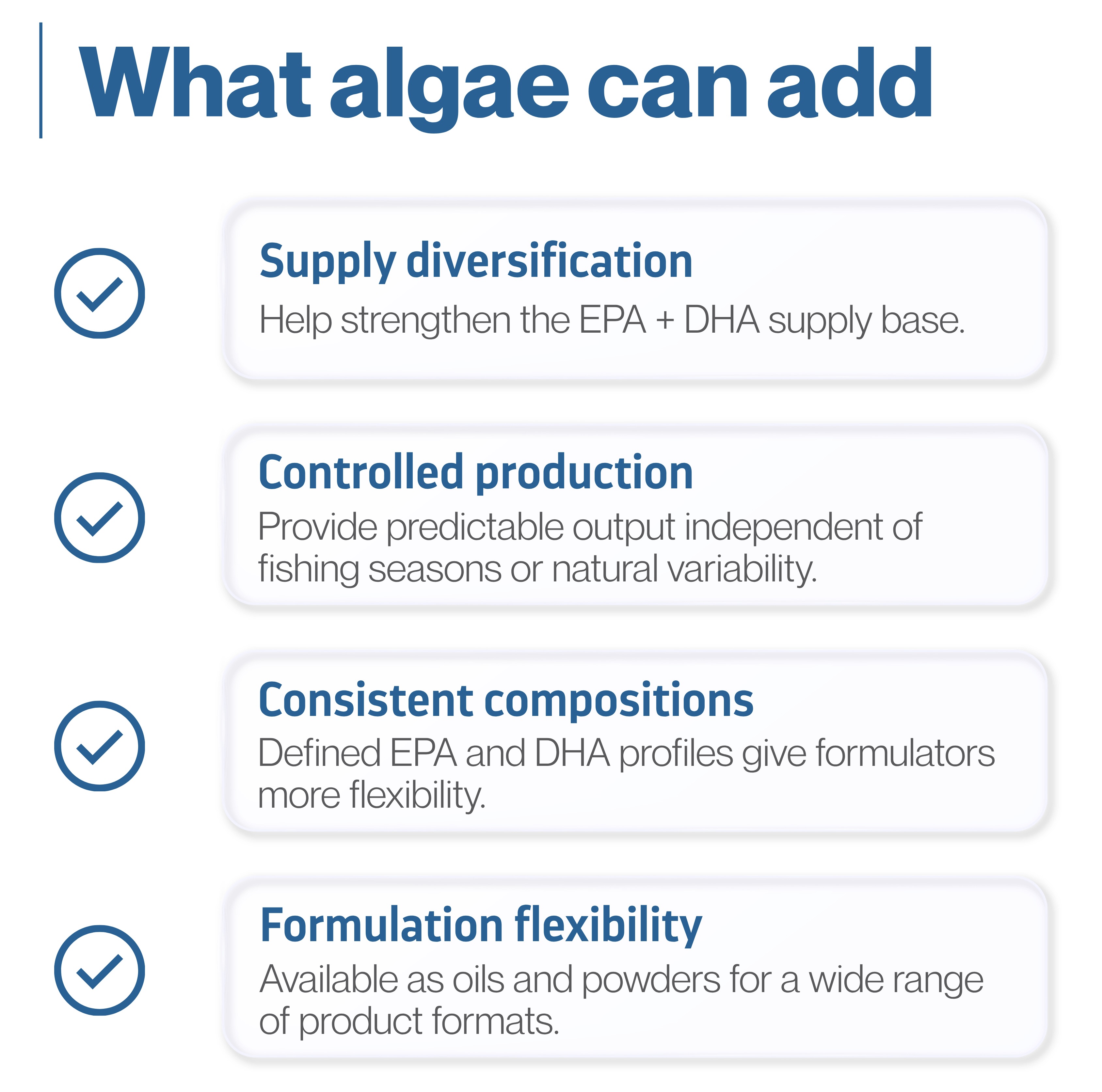 |
Controlled production can provide predictable output independent of fishing seasons or natural variability, while increasingly defined EPA and DHA profiles give formulators more flexibility. Higher concentrations, powders and other delivery technologies are also helping move algae EPA and DHA beyond traditional oil-filled capsules and softgels into beverages, bars, gummies and other formats.
There is no single role for algae in the market. It can support supply diversification, serve specific consumer preferences and meet different formulation needs depending on the product, audience and application. A broader range of EPA and DHA omega-3 sources ultimately gives the omega-3 industry more ways to reach consumers and meet global demand.

Key Findings
- Algae complements established omega-3 sources.
- Supply diversification and controlled production are important components of algae’s role in the market.
- Infant nutrition remains the established anchor, while supplements, prenatal nutrition, functional foods and beverages are expanding the application base.
- Pet nutrition and aquaculture are important current and future applications for algal EPA and DHA.
- Improved oils, powders and concentrations are creating greater formulation flexibility and more finished product options.
Member Perspectives
“Algae is a complementary platform that helps the omega-3 market grow with greater resilience, consistency and formulation freedom.” | “Microalgal oil is emerging as a strategic tool to diversify and derisk supply.” | “We see the greatest opportunity in expanding algae beyond softgels and liquid emulsions into functional beverages, gummies, bars and other consumer-friendly formats.” |
“Fish oil will remain a main source of omega-3, while algae can supplement the broader supply base.” | “Rather than simply replacing fish oil, algae oil provides a sustainable, stable and differentiated source of omega-3, while helping address supply constraints associated with limited marine resources.” | “It dominates infant formula (driven by purity and vegan/allergen-free positioning), plays a strong role in prenatal and clinical nutrition, and is expanding into functional food and beverage formats.” |
Contributors