Industry Insights
Algal omega-3s have moved beyond their early positioning as primarily a vegan or prenatal option. Advances in production, ingredient technology and market acceptance have broadened both the types of algal omega-3 ingredients available and the applications they can support.
GOED market data reflects that broader development. According to the 2026 Global EPA & DHA Omega-3 Ingredient Market Report, the global algae oil market reached 6,311 metric tons and $305.2 million in 2025, with volume increasing 3.8% from 2024.
Improved strain selection, fermentation efficiency and downstream processing have helped increase production capacity, improve consistency and narrow the economic gap with other omega-3 sources. At the same time, the availability of EPA-containing algae oils and combined EPA+DHA ingredient offerings has expanded the category beyond its traditional DHA base.
The changing global omega-3 supply picture has also influenced algae’s development. Variability in marine supply has increased interest in having multiple reliable sources of EPA and DHA omega-3s. Algae can contribute to that broader supply base, providing another option for companies seeking greater supply stability and risk diversification, while also serving applications that value a non-marine origin, consistent composition or controlled production. | 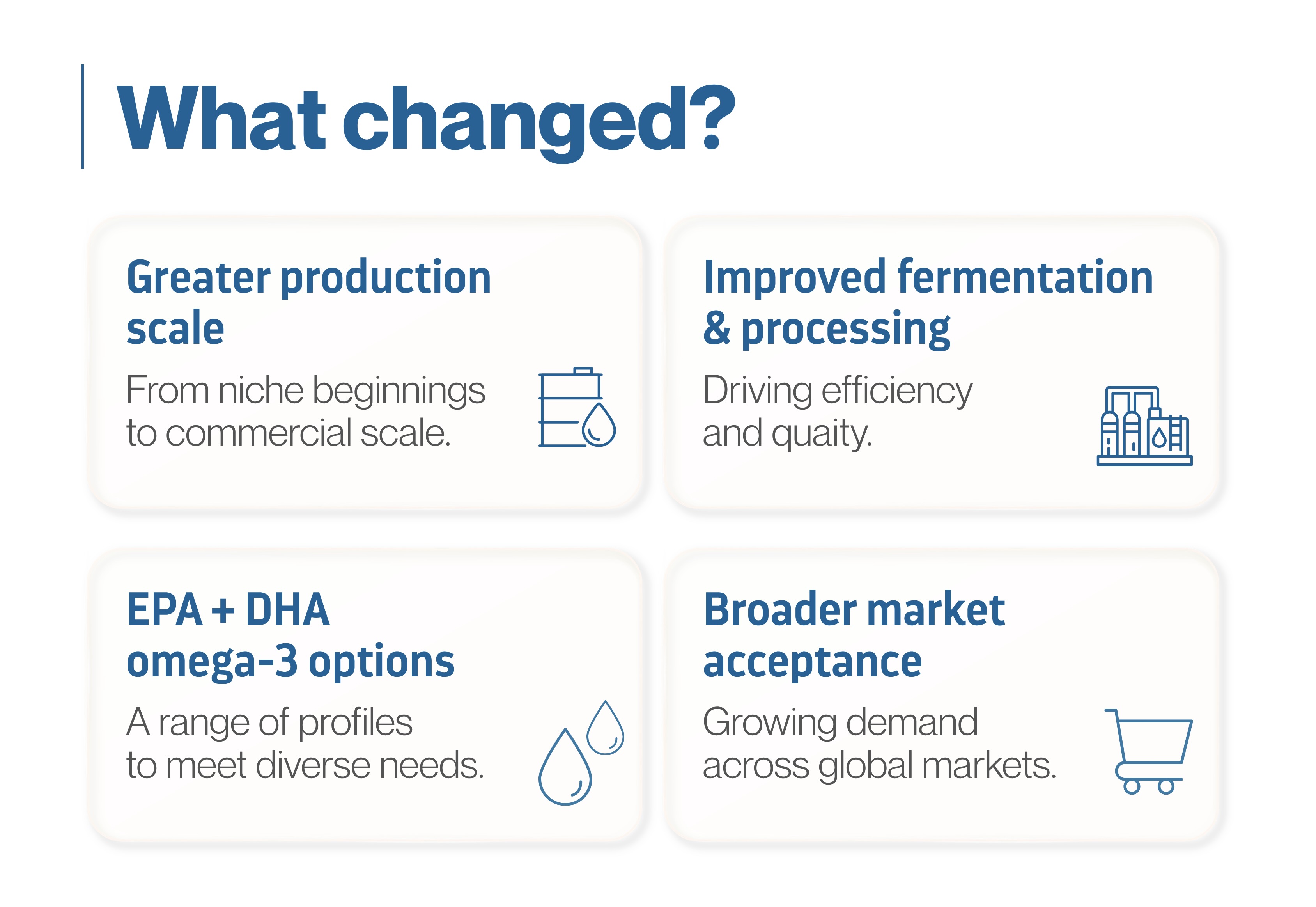 |
Market acceptance has evolved alongside production. Infant nutrition remains the important foundation, while dietary supplements, functional foods, pet nutrition and aquaculture are becoming increasingly relevant. The category is more established than it was five years ago, but its next stage will still depend on economics, capacity, education and application development.
Key Findings
- Omega-3s from algae have expanded beyond their early niche positioning.
- Improvements in fermentation, strain development and processing are supporting greater scale and consistency.
- EPA-containing and combined EPA+DHA algae oils are broadening formulation possibilities.
- A broader array of suppliers are helping diversify the EPA and DHA omega-3 supply base, which has become increasingly important as global supply conditions change.
- Regulatory developments and greater market awareness are helping open additional applications.
Member Perspectives
“Over the past five years, the algae omega-3 category has moved from niche to scalable solution, with growth across human nutrition, pet food and aquaculture.” | “The evolution lies in ongoing improvements in both cost and capacity. This leads to a major change – a move to microalgal oils as a more stable supply option.” | “Algae omega-3 has evolved from a niche, primarily DHA-focused ingredient into a broader, commercially relevant source of both DHA and EPA.” | “Consumers and manufacturers increasingly recognize microalgae as a high-quality, secure and reliable source of EPA and DHA.” |
“Over the past five years, the algae omega-3 industry has evolved significantly across policy, production and market adoption.” | “Five years ago, plant-based and vegan claims on omega-3 products were largely a marketing angle within a relatively small niche. That has changed. Consumers are increasingly seeking plant-based options, turning what was once primarily a positioning claim into genuine purchasing behavior.” | “Production has scaled significantly in several regions, reducing the cost of crude algae DHA and improving competitiveness in some applications.” |
Contributors